
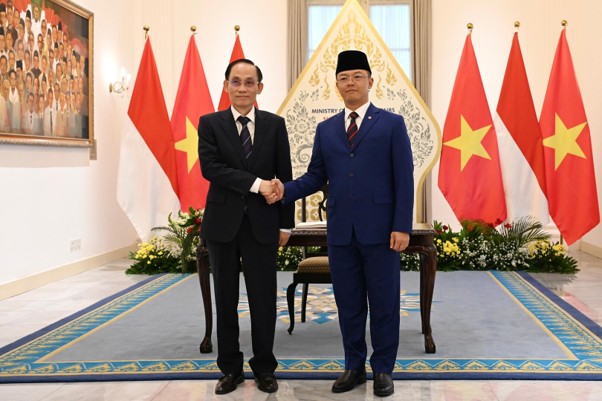
Photo Credit: Ministry of Foreign Affairs of the Republic of Indonesia (Kemlu RI) / Kementerian Luar Negeri RI
When Foreign Ministers Sugiono and Le Hoai Trung signed a five-year action plan in Jakarta on 14 July, the language was exactly what such occasions call for. The plan commits Indonesia and Vietnam to deeper cooperation on trade, electric vehicles, the digital economy, defense and maritime security. It was signed alongside the sixth Joint Commission on Bilateral Cooperation and described, correctly, as a milestone. Nobody could object to any of it, which is the first clue that it settles very little. The more revealing document is the one the two governments have spent more than a year not completing. That gap, between what gets signed and what gets ratified, is where the actual state of this relationship lives.
What the trade numbers do not say
Start with the part both sides were happy to announce. Bilateral trade reached US$17.2 billion in 2025, and the ministers reaffirmed a target of US$18 billion by 2028. The target is not new, dating from the upgrade to a comprehensive strategic partnership in March 2025, and Le Hoai Trung told the same July meeting that trade had almost reached it already. Set against the trajectory, it is close to meaningless: trade in the first four months of 2026 had already passed US$6 billion, up seven percent year on year. A goal the current pace will clear on its own is not an ambition. It is a forecast dressed up as one.
What the headline number hides is the composition beneath it. Indonesia runs the surplus, which looks like strength and is not quite. Indonesia sells coal, nickel, palm oil and intermediate goods. Vietnam sells finished manufactures, and sells them onward to the world through the CPTPP and its free trade agreement with the European Union, neither of which Indonesia yet has in force. Jakarta is not standing still: negotiations on an economic partnership agreement with the EU concluded in September 2025, the Commission sent the agreement to the Council for signature in June 2026 with entry into force targeted for early 2027, and preliminary CPTPP accession talks have opened. But an agreement that is not yet in force moves no containers this year. Both capitals call this complementarity. It is also a division of labor, and in a division of labor it matters a great deal which side does the assembling of value and which side supplies the inputs. On current terms, Indonesia supplies the inputs.
Electric vehicles are where that question stops being abstract. VinFast opened its plant at Subang in West Java last December, with more than US$300 million committed to the first phase of an investment the company says will exceed a billion. VinFast's own schedule, which has not been independently audited, raises local content from 40 percent this year to 60 percent by 2029 and 80 percent by 2030. The commitments are real and the jobs are real.
But local content rules measure where a car is put together, not who owns the parts of the process that generate the returns. A plant can hit every threshold on Indonesian land, with Indonesian workers and Indonesian tax breaks, while the engineering, the battery chemistry, the software and the brand stay in Hanoi. Whether Subang becomes the seed of an Indonesian automotive industry or simply a Vietnamese factory with an Indonesian address depends on details the action plan does not touch: which local suppliers get into the chain, and what technology actually moves, on what terms.
None of this makes the partnership hollow. It makes it a partnership between two governments that also defend their own producers the moment money is at stake, and both do. Vietnam this year imposed anti-dumping duties of up to 43.78 percent on Indonesian float glass, having found its own industry was being hurt. The measure is not aimed at Jakarta in particular, and hits Malaysian glass harder still, at up to 63.39 percent, which is rather the point: this is ordinary trade defense, applied to whoever is cheap. Indonesia does the same in reverse. Vietnamese rice exports to Indonesia collapsed by nearly 98 percent by value in the first five months of 2025, once Indonesian stocks made the imports politically unnecessary. Strategic partnerships in this region sit on top of that behavior. They do not restrain it, because nobody designed them to.
The boundary that is not law
Which brings us to the file that would genuinely matter, and the one the July meeting had least to say about. In December 2022, after twelve years of talks, Indonesia and Vietnam agreed their exclusive economic zone boundary in the South China Sea, the first EEZ boundary concluded between two Southeast Asian states in the disputed part of that sea. It was, and remains, a significant achievement: two governments resolving a maritime boundary between themselves, on their own terms, in waters China also claims. All it needs is ratification. It has not come, and it has not come from either side.
That is worth meeting head on rather than stepping around, because Vietnam has not ratified either. If both parliaments are silent, why read the silence as Jakarta's? Because the two silences are not the same kind. Hanoi has promised nothing in public and so has missed nothing in public. Jakarta has done both: Prabowo told To Lam in March 2025 that parliament would ratify after Eid al-Fitr; in May a member of the relevant commission said ratification was days away; the enabling bill had been harmonized and sent to the legislature the previous November. Nor do the two governments face the same bill for acting. Vietnam is an open claimant that already rejects the nine-dash line in public and loses little by putting a line on a map. Indonesia insists it is not a claimant at all, which is precisely the position ratification would make harder to hold. Hanoi's inaction is cheap and tells us little. Jakarta's is a decision.
More than a year on it has not happened, and the maps remain out of public view. This is not how Indonesian treaty ratification usually goes. It rarely takes more than a single parliamentary session, and Prabowo's coalition controls 470 of 580 seats, roughly four-fifths of the House; if the government wanted this done, it would be done. The obstacle is not procedural. The delimited waters fall inside China's nine-dash line, and those tracking the file point to Beijing as the reason for the stall.
The complication is partly of Jakarta's own making. In November 2024, a joint statement issued during Prabowo's visit to Beijing referred to “overlapping claims” in the South China Sea, wording that appeared to soften Indonesia's long-held line that it has no overlapping jurisdiction with China at all. Ratifying the boundary with Vietnam would draw a public, cartographic line through exactly the waters Beijing wants left ambiguous. It would state, on a map, where Indonesia's rights end and where China's claim has no standing. That is presumably why it keeps not happening.
So the achievement sits in limbo. The boundary exists on paper and shapes conduct at sea, where it was meant to reduce the fishing incursions that have long caused friction around the Natunas. But it is not law, and Jakarta is choosing not to make it law, because doing so would force a clarity it would rather avoid with a third party neither signatory will name out loud. The July action plan, with its warm language about maritime cooperation, is what fills the space where that decision should be. This is the pattern worth naming, because it is not confined to these two countries. Southeast Asian states have become fluent at signing and slow at finishing. The declarations, partnerships and upgraded tiers accumulate; the harder things, ratified boundaries, industrial depth, enforcement that means something, lag behind. ASEAN centrality is invoked constantly and delivered rarely, and documents fill the difference. None of this is failure exactly. A partnership that commits both sides to everything and binds them to nothing is doing precisely what it was built to do: it keeps the relationship warm and postpones every decision that would require someone to give something up. The honest test of the July plan is not the plan. It is what happens in the year after it. Watch whether local procurement in the EV sector actually rises, whether the non-tariff barriers actually come down, and above all whether the boundary is finally ratified in the open. Those are the things that would turn a photograph into a partnership. Until then, the most important fact about Indonesia and Vietnam in July 2026 is not the document they signed. It is the one they still will not.

Aniello Iannone is a lecturer in Indonesian and Southeast Asian Politics at the Department of Political Science and Government, Diponegoro University. His research focuses on Indonesian politics, ASEAN as a regional actor, and comparative and international politics in Southeast Asia.
In this article, Aniello Iannone critically evaluates the ten-year trajectory...
The global order is moving beyond rigid bloc politics toward...
In this article, Luo Chen Jun highlights a striking historical...
In this article, Muhamad Ferdy Firmansyah highlights how climate technology...
In his latest article, Aniello Iannone examines the gap between...
This article analyzes Indonesia's ambitious military modernization through its strategic...
DeepRare is being hailed as a major breakthrough in the...
This article analyzes President Prabowo’s decision to skip the June...
This article analyzes the phenomenon of "sibling rivalry" at the...
This article evaluates the normative frameworks offered by China’s four...
This article examines the 2025 Thailand–Cambodia border conflict to evaluate...
This article examines the May 2026 ASEAN Summit in Cebu...
This article examines the May 2026 Beijing summit between Xi...
This article examines how the rise of narcissistic foreign policy—exemplified...
In October 2025, Indonesia's President Prabowo Subianto announced that Portuguese...
This article argues that recent U.S.–Israel military actions against Iran...
This article examines Türkiye’s evolving "Third Way" in Africa, an...
This article critically examines Indonesia’s evolving role from a quiet...
This article provides a firsthand account of how Pakistan emerged...
This article examines how disruptions in the Strait of Hormuz...
This article examines Indonesia’s participation in the Board of Peace...
This article examines what the attempted sale of CK Hutchison's...
This article examines the Kudankulam Nuclear Power Plant as a...
This article examines Nepal’s strategic position within the Indo-Pacific and...







Leave A Comment