
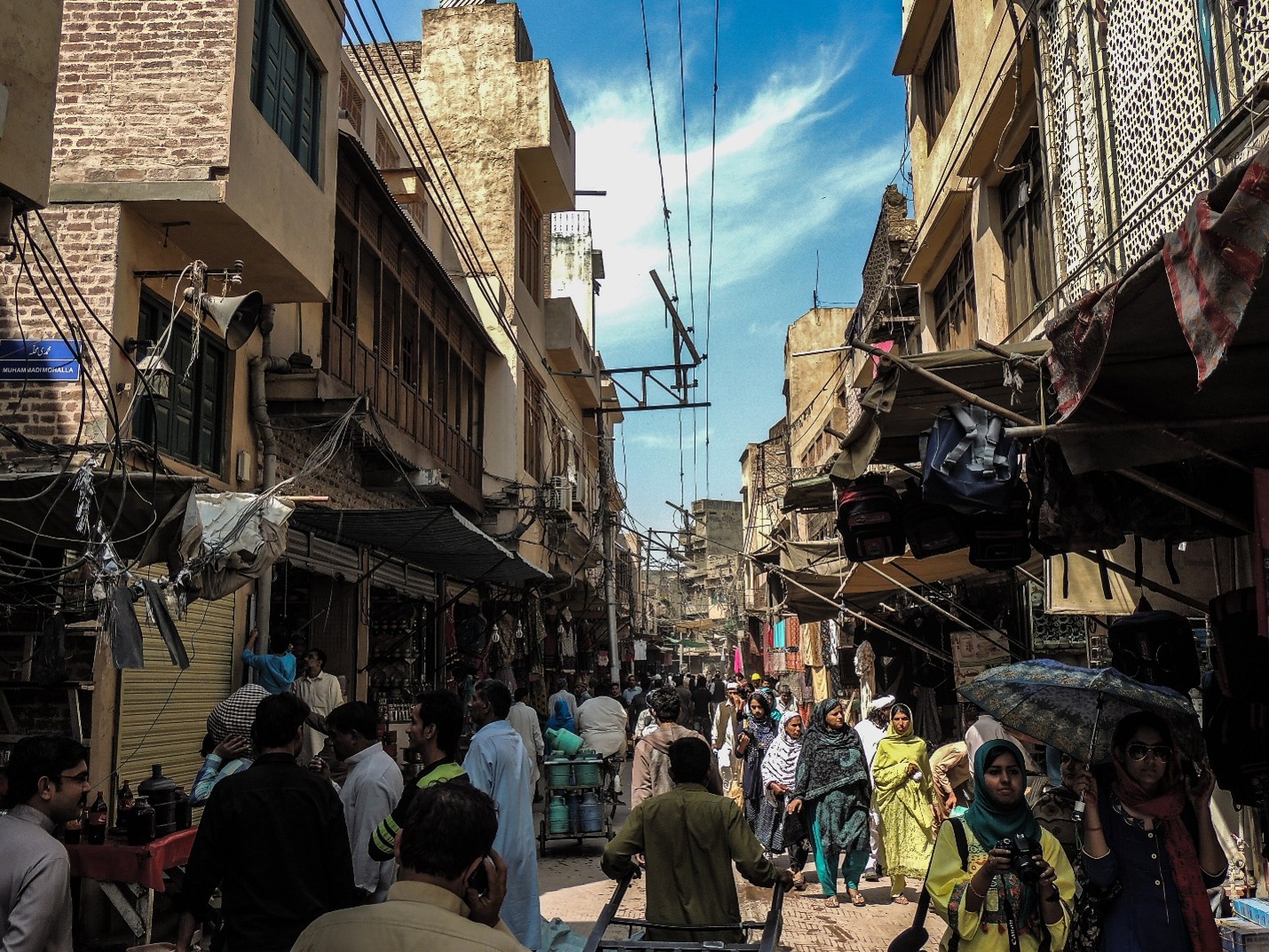
The Bazaar outside Wazir Khan Mosque. Razaawais141, CC BY-SA 3.0, via Wikimedia Commons.
In Pakistan, a quiet but consequential negotiation is under way. Millions of women are studying longer, working more, and connecting through their phones. But the terms on which they do so are rarely entirely their own. Before a daughter enrols in a university across the city, before a wife accepts a remote-work contract, before a young woman opens a freelancing account, a conversation must first happen. A father, husband, brother, or sometimes a mother-in-law must be persuaded, consulted, or at minimum not actively opposed. This is the permission economy: a social arrangement in which women's expanded opportunities are real, but remain conditional on familial approval.
The term is not an official policy category. It describes an informal but structurally durable system in which women's access to education, mobility, and economic participation is mediated through gatekeepers whose consent functions as a prerequisite. This is distinct from outright prohibition. In a permission economy, the door is not locked; it is guarded. Women are not told they cannot study or earn. They are told, sometimes explicitly and often through social pressure, that they may, provided certain conditions are met: that they return home before dark, that the employer is deemed respectable, that the work does not require mixing with unrelated men, that the income supplements rather than disrupts the household hierarchy. The distinction between prohibition and permission may seem subtle. In practice, it determines the texture of millions of women's daily lives.
Consider three scenarios that many observers of Pakistani society would recognize as ordinary. A young woman in Faisalabad wants to attend a morning university programme across the city. Her father agrees, but only if her older brother drops her off and a female cousin accompanies her home each afternoon. She accepts. The cost is significant: her brother loses two hours of work daily, and she incurs an ongoing social debt that will shape future negotiations. She has gained access to education, but its terms are not her own.
Elsewhere, in a mid-sized Karachi apartment, a married woman has begun taking graphic design orders through an online platform. Her husband does not object, as long as she does not list a professional name on her public profile and avoids communicating with male clients by voice. She manages the constraint by routing all communication through text. Her income is real. Her visibility as a professional is carefully contained.
In a third scenario, a woman in Lahore who has been offered a full-time office position finds her in-laws unwilling to agree. She counter-proposes a remote arrangement with the same employer. After two weeks of discussion, the family concurs. The job is the same. The permission required a different shape. These are not stories of dramatic repression. They are illustrations of how opportunity and constraint coexist, how women adapt to the terms available to them, and how a great deal of social labor goes into securing outcomes that might, in other contexts, require no justification at all.
What makes this moment distinctive is that several forces are converging simultaneously, producing real but uneven change.
Female enrolment in higher education has grown considerably over the past two decades. According to analysis drawing on Higher Education Commission data, the female-to-male ratio in tertiary enrolment has improved markedly in recent years and, in some years, has approached parity at the national aggregate level. This masks large disparities, however. Only around 22 percent of university students come from rural areas, and among that group, female enrolment drops to 31 percent. Urban centres see a starkly different picture, with women making up more than 56 percent of students. Families are not necessarily educating daughters to liberate them. They are doing so to improve marriage prospects and, increasingly, household earning potential. The result is a form of instrumental investment in girls' education that sits comfortably within conservative frameworks.
Economic pressure has been a second, quieter driver. Pakistan's persistent inflation and employment uncertainty have made the single-income household financially difficult to maintain for a large portion of the urban middle class. According to World Bank data, Pakistan's female labour force participation rate stood at approximately 24 percent in 2024, well below the global average of 51 percent. Families that once defined their respectability through the image of a wife who did not need to work are finding that ideal harder to sustain. This is permission granted by necessity rather than by conviction. It is a real opening, but an unstable one. If economic conditions shift, or if a male relative's circumstances improve, the permission may quietly contract again.
Smartphones and digital platforms have introduced a third disruption. According to the GSMA Mobile Gender Gap Report 2025, mobile internet usage among women in Pakistan rose from 33 percent in 2023 to 45 percent in 2024, a 12 percentage point increase described as the largest recorded among all countries surveyed that year. This growth was driven largely by rural women, with around 8 million women coming online in 2024 alone. Yet significant gaps remain. According to Freedom House, as of mid-2023, women constituted only around 24 percent of mobile broadband subscribers, and religious, social, and cultural norms continue to discourage women from owning devices and accessing the internet independently. A woman who cannot leave her neighbourhood unaccompanied can, in principle, run a home-based business, complete an online course, or correspond with a professional network. The phone becomes a partial workaround for the mobility restrictions that the permission economy imposes.
Pakistan's freelancing sector has grown into a significant part of the digital economy. According to the Pakistan Freelancers Association, Pakistan ranks among the world's top five freelancing markets, with more than 2.3 million active freelancers contributing to digital exports. Women account for an estimated 28 percent of participants in the government's DigiSkills.pk training programme, which has conducted over 4.55 million sessions to date, according to reporting drawing on Pakistan Economic Survey 2024-25 data.
The Pakistan Labour Force Survey 2024-25 confirms a clear gender dimension to gig work. Women are concentrated in teaching and selling goods online, while men dominate mobility-intensive categories such as taxi services and delivery. Women appear to have entered home-based digital work in significant numbers, often precisely because it sidesteps the more complex family politics of office employment. The arrangement satisfies gatekeepers because it keeps the woman physically present and visible at home. It provides economic activity she might not otherwise have been permitted to pursue.
Global discussions of gender equality often frame women's autonomy as an individual right to be asserted against social constraint. From that vantage point, Pakistan's permission economy looks like an obstacle to be dismantled. That framing, while not without merit, is inadequate to what is actually happening.
For many women in Pakistan, autonomy is not primarily experienced as an individual entitlement. It is exercised within a web of relationships, obligations, and interdependencies. A woman who works, studies, or moves through public space while maintaining her family’s trust and her own social standing has achieved something real. It is not a diluted version of some purer ideal of freedom. It is the form of agency available to her in the world she actually inhabits.
This negotiated autonomy is not simply passive acceptance of constraint, though coercion and internalized norms exist and should not be minimized. In many cases, it reflects a rational assessment of available options. Rupturing family ties carries substantial costs: social isolation, loss of financial support, reputational damage, and in some circumstances physical risk. Women who negotiate rather than confront are not necessarily compliant. They are often strategic, and their strategies deserve to be taken seriously.
Women who enter the workforce, even on conditional terms, accumulate skills, professional contacts, and in some cases a degree of financial independence they did not previously possess. The fact that autonomy is negotiated does not make it meaningless. It makes it precarious and unevenly distributed.
Conditional autonomy is, by definition, revocable. When a woman's access to opportunity depends on sustained familial consent, she is permanently in a posture of justification. She must manage not only her work and domestic responsibilities, but also the ongoing task of keeping her permission intact. This is an exhausting and largely invisible form of labor.
There is also a harder edge that cannot be overlooked. In some situations, negotiation gives way to control. According to the Sustainable Social Development Organisation's Mapping Gender-Based Violence in Pakistan 2024 report, a total of 32,617 gender-based violence cases were reported across Pakistan in 2024. These included 5,339 incidents of rape, 2,238 cases of domestic violence, and 547 honour killings. The national conviction rate was 0.5 percent for rape and honour killings and just 1.3 percent for domestic violence. A UN Women Safety Audit conducted in 2020 found that more than 80 percent of women reported facing harassment in public spaces, and the majority had normalized this as part of daily life. These are not marginal conditions. They define the environment within which permission is sought and granted.
The permission economy does not affect all Pakistani women in the same way. Women from upper-middle-class and elite families in major cities often operate in social environments where professional participation by women is relatively normalised. The gatekeeping function exists but is weaker. For working-class women in the same cities, economic necessity may create more openings, but it also creates more exposure to exploitation and fewer of the protections that professional status and family connections can provide.
The gap between rural and urban contexts is substantial. Rural internet access in Pakistan remains far below urban levels, and female mobile internet usage nationally remains around 41 percent lower than that of males, according to analysis drawing on Pakistan Telecommunications Authority and GSMA data. The digital route that has partially opened doors in cities is far less available where connectivity is poor and digital literacy limited. A national narrative of women's progress can obscure the fact that observable gains appear concentrated in urban, educated, and relatively affluent populations.
Pakistan has constitutional protections for women's rights, and some provincial governments have taken legislative steps to address specific gaps, including the Punjab Protection of Women against Violence Act 2016. Yet the distance between written law and lived reality is large. Formal legal reform matters. But the permission economy is largely a social phenomenon, and legislation alone does not reach it directly.
What tends to shift things, at least at the margin, are policies that alter the practical conditions under which negotiation happens. Expanding women's access to digital infrastructure and affordable internet allows more women to earn without leaving home, which changes the terms of family deliberation. The Pakistan Telecommunications Authority's Digital Gender Inclusion Strategy, drafted in 2024, is one such effort. Vocational training programmes designed around flexible, home-compatible formats can similarly expand the range of options available to women whose movement is constrained. Microfinance mechanisms that do not require male cosignatory approval remove one layer of gatekeeping from the economic sphere.
Education policy also carries weight, though the type of education matters as much as the quantity. Where girls' schooling is designed primarily to improve marriage prospects, it tends to reinforce rather than loosen the permission economy. Approaches that build economic literacy, critical thinking, and awareness of legal rights are more likely, over time, to produce women with stronger footing in the negotiations they will face.
Pakistan is not moving toward a single predictable destination. The country holds within it conservative rural communities where the permission economy is nearly absolute, urban professional environments where it barely registers, and an enormous middle ground where it is being quietly contested and slowly renegotiated. In many urban areas, the direction appears to be toward broader practical autonomy, even where formal structures of family authority remain intact.
What is clear is that change in Pakistan’s gender landscape is moving through negotiation rather than confrontation, through pragmatism rather than ideological rupture, and at a pace shaped deeply by class, geography, and access to technology. The permission economy is not simply an obstacle awaiting removal. It is the terrain on which millions of Pakistani women are, right now, doing the slow and largely unrecognized work of expanding what is possible. Taking that work seriously, rather than measuring it only against an external standard it was never designed to meet, is where any honest conversation about supporting it must begin.

Rehan Zayer is a Pakistani writer and an International Priority Scholar at Universitas Muhammadiyah Surakarta, Indonesia. His work examines gender, culture, education, and digital life in the Global South. He writes at the intersection of public scholarship and interdisciplinary debates on society, language, and social change.
In this article, Affabile Rifawan examines the shifting landscape of...
This article examines how Indonesia’s nickel downstreaming policy has driven...
This article examines the "permission economy" in Pakistan, an informal...
This article examines how the illicit smuggling of critical minerals...
This article argues that poverty and uneven development in the...
This article explores how the Global South is reevaluating its...
This article examines the challenging path for Indonesia to meet...
This article analyzes Nigeria’s attempt to convert carbon credits into...
This article examines how Indonesia’s MBG program, while reaching more...
This article critically analyzes the 17th BRICS Summit communique, highlighting...
This article explores what Indonesia’s upcoming Digital Rupiah can learn...
This article explores how Indonesia can transform its steady economic...
This article discusses how global ESG standards, mainly created within...
This article explores Indonesia’s resilient people-based economy, driven by 65...
This article examines Indonesia’s 2025 economic turmoil, marked by a...
This piece explores how Pakistan can harness its rich cultural...
This incisive piece unpacks the deeper logic behind Trump’s so-called...
This article introduces Sustainable Prosperity Investing (SPI) as a hybrid...
This article examines how globalization challenges the authority of Islamic...
This article examines Danantara, Indonesia’s recently launched sovereign wealth fund...
This article explores how digital payment systems are reshaping financial...
This article explores the expansion of Islamic banking beyond Muslim-majority...
This article examines the impact of Trump’s aid cuts on...
Nestled within the Singapore-Johor-Riau Growth Triangle, Bintan Island has quietly...



Leave A Comment