
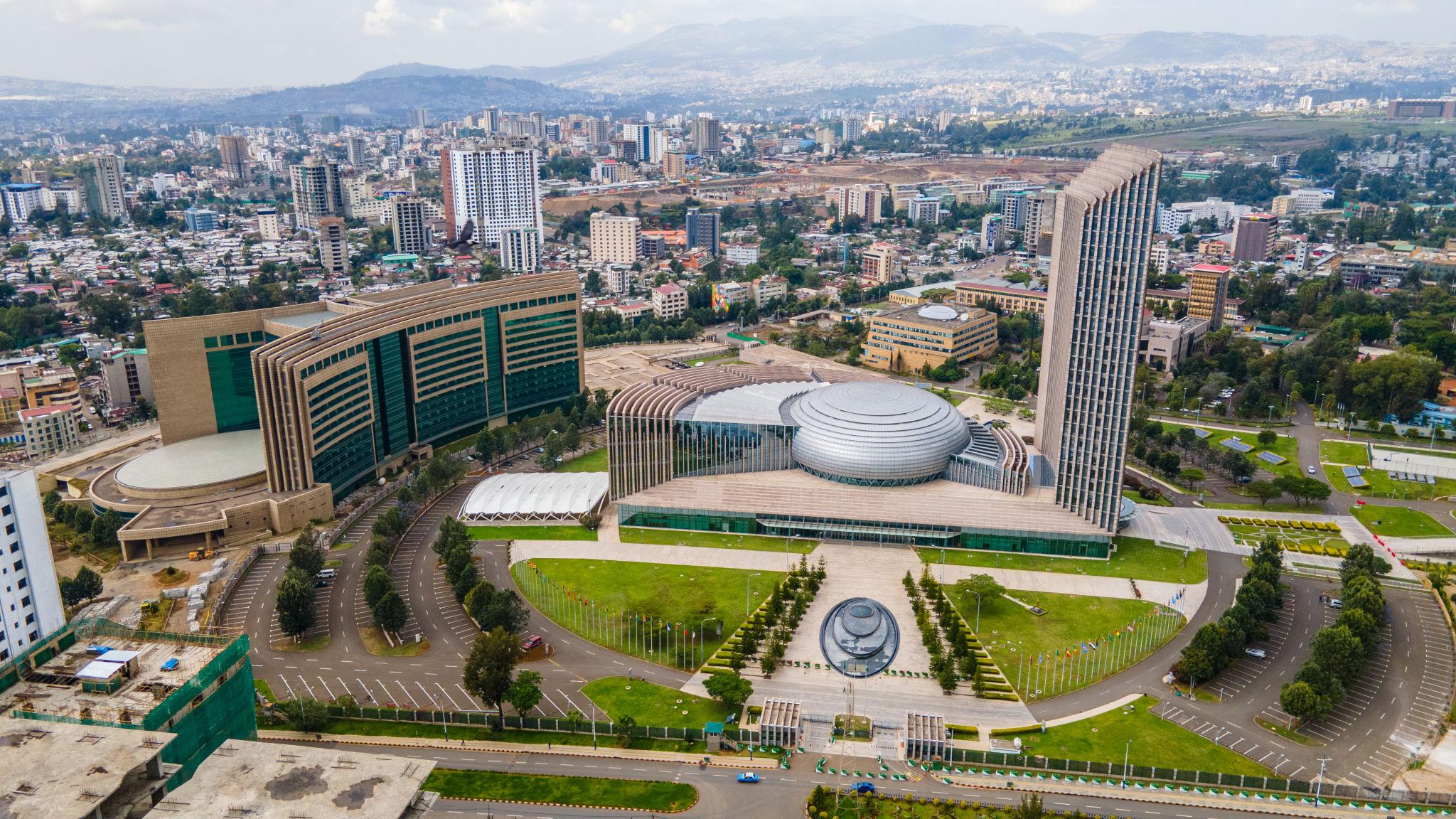
The African Union Headquarters on Addis Ababa. Credit to @Habte Zewge via dreamstime.com.
There is a specific feeling of loneliness which results from loving Africa with excessive passion. The knowledge that one wants to see the continent achieve economic independence, social justice and political freedom marks a Pan-African as a target for surveillance, detention, exile, and the worst consequence, death. “My days are numbered” serves as more than just a dramatic expression for Pan-African activists, journalists and intellectuals. The work of liberation results in a daily body counts which people involved in the work use to track their progress.
The Pan-African dream creates a perilous threat because it challenges the existing systems of resource extraction. The practice of pushing African nations to take control of their resource wealth, financial systems and governmental authority is not a simple viewpoint but an action that endangers multinational corporations, military installations and establishes a security threat for corrupt local leaders who protect international investors. The response is both expected and violent.
The disappeared and the dead
The Pan-African goals of Thomas Sankara put him in danger because of his position as Burkina Faso’s revolutionary president. He achieved the He launched a mass vaccination campaign within weeks of taking office. He established a program which successfully planted 10 million trees to combat desertification through his announcement that “he who feeds you, controls you” and his decision to turn down all foreign assistance which came with imperial conditions.
He prohibited female genital mutilation and polygamy and forced marriages while choosing women to fill 50 percent of his cabinet roles in 1987. His closest ally Blaise Compaoré organized his assassination through a coup which received French intelligence support. Sankara understood the price which needed to be paid. He wrote that “revolutionary movements can kill individual revolutionaries” but “revolutionary movements cannot die because they are ideas.” People need to learn that ideas do not give them protection against bullets.
The pattern repeats with sickening regularity. The 2011 execution of Muammar Gaddafi in Libya killed by rebel forces during the NATO-backed Libyan civil war, occurred after his 40 years of supporting African countries to achieve monetary independence through his proposal of a gold-backed dinar which would have challenged the CFA franc control over 14 African nations. Gaddafi operated as a hero to some and a villain to others because his assassination sent an obvious message that military force would be used against anyone who tried to establish economic Pan-Africanism.
In 2015, Itai Dzamara, a Zimbabwean journalist, disappeared after he organized pro-democracy demonstrations and demanded the resignation of President Robert Mugabe. Dzamara, who worked as a journalist, became an activist before five unknown men abducted him from a barbershop during daylight. The police failed to provide answers despite court orders which mandated them to investigate the case. Sheffra, his wife, keeps searching for him and for his remains. The impunity of his disappearance sent a clear message that people who criticize powerful authorities too effectively would be erased from existence.
The machinery of enforced disappearance now operates in Tanzania with an efficiency that observers deem deeply alarming. This was starkly illustrated in the case of Humphrey Polepole—former Tanzanian Ambassador to Cuba and senior figure in the ruling Chama Cha Mapinduzi—who was abducted from his Dar es Salaam residence in the early hours of October 6, 2025. His family immediately reported him missing after a group of men broke into the house. Polepole’s trajectory from insider to outspoken critic of the regime, particularly his claim that President Samia Suluhu Hassan’s youngest son covertly serves as an intelligence chief alongside the Director-General of the Tanzania Intelligence and Security Service, underscores the peril faced by dissenters in the current political climate.
Peter Kibatala and other top lawyers organized a habeas corpus petition to the court which demanded that state authorities reveal Polepole’s current status whether he was “dead or alive.” His current location remains unknown and he has joined the list of more than 100 abductions which Tanganyika Law Society has documented under Hassan’s leadership. The government system protects nobody from consequences when they challenge power that rests within a single authority.
The living exiles
For those who escape death, there is the limbo of exile. The activist Kemi Seba who conducts public CFA franc note burnings and demands France to remove its military forces from Africa has faced arrest in three different countries which are Senegal, Benin and France. He travels between nations using only temporary documents because his passport has been revoked yet he remains stateless after challenging the financial imperialism which requires African nations to pay for French public facilities while their educational institutions deteriorate.
Kenyans know this cost intimately. Miguna Miguna, a lawyer and Pan-Africanist who administered the oath to opposition leader Raila Odinga as “the people’s president” in 2018, was subsequently deported to Canada despite holding no Canadian citizenship at the time of his birth. The government declared him a “foreigner” in his own country, stripping him of his passport while he was physically dragged onto a plane. He spent years in exile because he questioned electoral theft and elite capture yet he could not attend his children’s graduations or his parents’ funerals.
Stella Nyanzi, an academic and feminist activist, spent 18 months in prison for writing a poem that used vulgar language to describe President Yoweri Museveni’s birth. Her actual offense involved linking women’s bodily rights to political responsibility while she argued that Pan-African liberation must include gender equality rights. After she was released from prison, she escaped to Germany where she writes about her life as she observes her children growing up through digital screens.
The asylum seekers
Then there are those whose names never make headlines, the grassroots organizers who flee with nothing but encrypted contacts and trauma. The Cameroonian activists who escaped the Anglophone crisis after they documented military atrocities. The Sudanese resistance committee members who organized neighborhood defense during the 2019 revolution now await UNHCR interviews which require several years to complete from their locations in Cairo and Nairobi. The Burundian journalists who reported on extrajudicial killings now work as dishwashers in Kigoma while they observe their former colleagues’ names appear on death announcements.
These are not criminals. They are teachers who taught critical thinking, students who organized cost-of-living protests, musicians whose lyrics mentioned “the people” too many times. The people arrive in foreign cities with advanced degrees and empty pockets because their qualifications remain unrecognized and their trauma remains untreated. The psychological cost of Pan-African ambition is measured in sleepless nights, in the hypervigilance of restaurant tables with views of exits, in the guilt of safety while comrades remain caged.
Tanzania has lost its status as a stable democracy because it now serves as the main source for political exiles. Tundu Antipas Lissu, who leads the CHADEMA opposition party, has survived multiple assassination attempts that Tanzanian authorities made against him. On September 7, 2017, Lissu was shot 16 times by unknown assailants armed with AK-47s outside his parliamentary residence in Dodoma, which had strong security protection because it served as a governmental facility. He needed to have 24 surgical procedures completed in both Kenya and Belgium, while he lost his parliamentary seat in 2019 because of his long recovery period.
Following the fraudulent 2020 elections where President John Magufuli claimed an implausible 84% victory, Lissu fled to Belgium because he received death threats which contained the exact words “we are going to deal with you… we have been instructed to deal with you once and for all.” He spent five years in exile before returning in January 2023 but he was arrested again in April 2025 on treason charges which could result in the death penalty. He remains imprisoned at this time with his trial taking place in private.
Godbless Lema, who served as a CHADEMA parliamentarian from 2010 to 2020, followed the same path. Lema faced arrest with other opposition leaders after the 2020 elections because they protested the rigged election results. He entered Kenya with his wife and three children after police released him on bail with reporting requirements but he obtained political asylum in Canada during December 2020. Lema described his refugee paper signing experience to The Globe and Mail by saying “I was crying”. “We never had to sign such papers in the past”. “This is a very bad experience for us.” “It’s a defeat for my country.” He currently resides in Saskatoon, where his children experience snow for their first time, while he waits for Tanzania to achieve “international corridors” status which will enable him to conduct organizing activities.
Even those who attempt to operate through digital platforms face the same machinery of repression. The satirical podcasting duo of Joseph Mrindoko and Jackson Kabalo who perform under the name Wachokonozi have reached a YouTube audience of more than 33,000 subscribers through their critical analysis of Tanzania’s national debt and electoral honesty and social matters. The police stated that they arrested them for “misusing social media platforms” which falls under the Cybercrimes Act yet their families experienced a period of uncertainty about their survival status for several hours. The case depicts how Tanzanian activists seek refuge in Kenya and other countries because the state perceives all forms of dissent as terrorist threats despite the fact that authorities later brought charges against the activists.
The pattern extends beyond Tanzania’s borders. The activist Maria Sarungi Tsehai who fled to Kenya after her land rights and freedom of expression work made her a target, she was kidnapped by masked men who forced her into a black van and attacked her while demanding her mobile phone password. The safety of exile remains uncertain because authoritarian powers can pursue their targets across international borders.
The economics of silence
Why does this continue? The situation exists because Pan-African economic liberation challenges the existing global power structure. The 2021 coup against Alpha Condé occurred after he proposed to change mining contracts with foreign mining companies. The ECOWAS organization-imposed sanctions on Assimi Goïta after he requested French troops to withdraw from Mali together with the establishment of Malian control over its gold resources. The message is plain: African sovereignty is tolerable only where it does not disrupt the flow of raw materials to Europe and Asia.
The social dimension is equally policed. The LGBTQ+ activists in Ghana and Uganda link their queer liberation work to their broader efforts against neocolonialism because they must confront both state violence and political elites who use African values as weapons against them. The Kenyan government brands land defenders in Lamu County who oppose Chinese coal plants as anti-development terrorists. Foreign capital and local patriarchs both target the Pan-African who believes liberation requires intersectional solutions that address class and gender and sexuality and ecology.
The stubborn persistence of hope
The work continues because, for those inside it, stopping is not an option. The diaspora community works to create digital archives which document lost historical records while teaching incoming activists how to use encryption methods and secure communication systems. They establish study circles in refugee camps to analyze the works of Walter Rodney and Amílcar Cabral. They bring legal cases against torture and illegal detention to courts from The Hague to various African regional tribunals with the understanding that the legal process will continue beyond their personal lifetimes.
There exists a special bravery which enables someone to maintain their affection for a continent which attempted to take their life. The courageous acts of Thomas Sankara planting trees he would never see mature, Itai Dzamara’s children maintaining his empty chair at dinner, Kemi Seba burning currency through which he would lose his protection, and Tundu Lissu choosing to return to Tanzania despite knowing the bullets would complete their mission from 2017. These people do not exist as simple-minded dreamers. They are people who have looked directly at the cost of Pan-African ambition and chosen to pay it anyway.
“My days are numbered” is not surrender. The recognition of time as a limited resource requires people to dedicate their existence to purposes beyond basic survival needs. The recognition of time as a limited resource requires people to dedicate their existence to purposes beyond basic survival needs. For Pan-Africans throughout Africa and in exile, their remaining time on earth serves as a liberation countdown which needs to be measured through the continent’s gradual and permanent discovery of its own capabilities.
The question is not whether they will stop. The question is whether the rest of us will finally listen before the numbering runs out.

Peseo Lao Pio is a Tanzanian national and ICT professional pursuing a Master’s degree in Political Science at Universitas Islam Internasional Indonesia (UIII). His research interests focus on African political economy, Pan-African thought, and the dynamics of global resource extraction and sovereignty.
In "Lebanon's chronic blackout issue is not just an engineering...
This article asks whether Indonesia is showing early symptoms of...
This article documents the systematic repression of Pan-African activists, journalists,...
This article looks at how Pakistan's 2024 General Elections were...
This article examines the tragic death of a child in...
This article examines poverty alleviation efforts in Kebumen Regency, Central...
This article critically examines Indonesia’s Makan Bergizi Gratis (MBG) programme,...
This article examines the socio-political impact of Pandji Pragiwaksono’s stand-up...
This article examines the persistent "political masculinity" in Indonesia, 41...
This article examines why Islamic political parties in Indonesia remain...
This article examines the global rise of school meal programs,...
This article examines Dhurandhar not merely as a commercial Bollywood...
This article highlight the development of IT that has been...
This article explores how Afghan women are using social commerce...
This article examines how youth-led, digitally networked movements are reshaping...
This article examines proposals to privatize religion not as neutral...
This article traces how a tense India-Pakistan cricket game, complete...
This article explains how the Pakistan-Saudi Arabia Strategic Mutual Defence...
This article examines how Afghan women have transformed the struggle...
This article explores how special autonomy in Aceh and Bangsamoro...
This article examines how Malaysia’s political economy sustains social harmony...
This article critiques the Global Innovation Index (GII) for overlooking...
This article examines how technology has become a highly contested...
This article takes a deep dive into Indonesia’s evolving struggle...








Leave A Comment